Archiv der Kategorie: Uncategorized

Travel Guide – Chuubu (North)

中 部 地 方 (C H Ū B Ū)

wikipedia DE / wikipedia EN / japan-guide
[Deutsche Version]

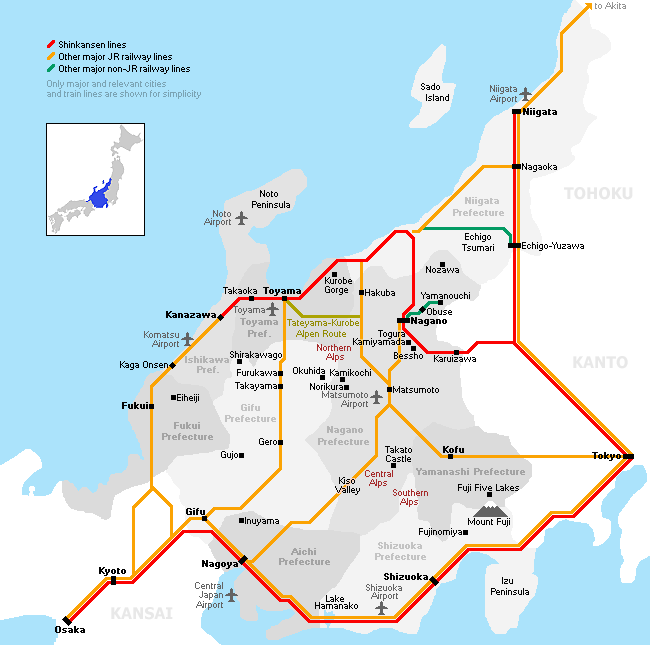
Chuubu is the region between Kansai (Osaka and Kyoto) and Kanto (Tokyo). Historically is Chuubu usually a part of the Kansai-Region. The nine Chubuu prefectures are Shizuoka, Aichi, Yamanashi, Nagano, Gifu, Fukui, Ishikawa, Toyama and Niigata. The eastern border runs from the Izu peninsula up to Niigata. The western border runs west of Nagoya in northwest direction. Lake Biwa is part of Kansai. Sum up: (rule: SHOULD is MUST if CAN):

  • MUST: Hida-Takayama, Shirakawa-go/Ainokura
  • SHOULD: Hida-Furukawa, Nagano, Matsumoto, Yudanaka/Shibu Onsen, Kanazawa
  • can: Eihei-ji


[I’m a fan of japan-guide.com. The picture is a URL link]

In the south of Chuubuu, along the shoreline, are the Tokaido-Shinkansen-tracks. Since 2015 (?) the Joetsu-Shinkansen, who connects Tokyo with Nagano,  terminates at Joetsu-Myoko at the northern coast. From there starts the Hokuriko-Shinkansen, follows the northern shoreline, and terminates in Kanazawa. (It is planned to extend the Hokuriko further to Fukui an then back down to the Tokaido tracks.) The northernmost prefecture Niigata is supported by the Niigata branch of the Yoetsu-Shinkansen.

Main lines running from Nagoya thru the Kiso valley via Matsumoto to Nagano. Another line is going from Nagoya via Gifu to Takayama and further to Toyama. An the norhtern shoreline is another line that (coming from Kyoto) connects Fukui, Kanazawa, Toyaa, Myoko and Nagaoka. Beside Japan Rail are operating many other train companies.

I have seperated Chuubu into a north part and a south part. The divider is the Nakasendo / the Chuo train line. Highlights are Takayama, Shirakawa-go and Kanazawa. Beside that there are Nagano, Shibu and Matsumoto worth mentioning.


(飛騨)高山 : Hida-Takayama — MUST VISIT, 2 days+

Takayama is for sure a must visit. Maybe not for the first visit to Japan, when you are busy with Tokyo, Kyoto, Kamakura, Nikko and all the other cities along the Shinkansen tracks. But it will be a highlight at your second trip. The old city center is an area ov several narrow streets with old wooden houses. There is an open air museum close by and twice a year there is a big famous festival, that is mentioned in every tour guide to Japan. You should plan two days, during the festival time maybe three. — Furukawa is worth a day trip. And there are busses to Ainokura. A remote place with old farm houes in the middle of nowhere. Ainokura and the village Shirakawago next by are Unesco World Heritage, like Takayama itself.


(飛騨)古川 : Furukawa — SHOULD, 1 day

Furukawa is a good destination for a day trip from Takayama. It is a small town. There are two temples a craftsmen museum, you should visit. They show how Japanese built there houses; how the connect the peaces of wood without nails. Very Intersting. There are some nice streets. All together a nice place. Including the train travel you need less than a day.


白川郷: Shirakawa-go / 相倉: Ainokura — MUST VISIT, 2 days

Shirakawako and Ainokura are two remote villages in the mountains. The time forgot these places centuries ago. Nothing happens here. But that is the reason you have to visit these towns. It is a peace of acient Japan. I stayed in Ainokura in winter time, several metre of snow. Most of the old houses are converted into minshuku (japanese version of B&B). After my stay in 2012 this place and a night in the houses is a „must visit“; but only in winter time.

There are bus connections (pricy) from Takayama and from Kanazawa too. So there is chance to you the place for a travel route from the south coast (Nagoya) via Takayama to the northern coast (Kanazawa).


金沢 : Kanazawa — SHOULD, 1 day

Kanazawa has the Kenroku-en; one of the three famous perfect japanese gardens. The castle of Kanazawa is under recontruction bit by bit. But for now the is no charactistic central tower. There are also two streets with old tea houses. And there is a fish market where you can buy good sashimi and sake. Kenroku-en is a must visit, but the rest is only a can visit. In total it is a should visit for Kanazawa. Since 2015 Kanazawa is connected to the shinkansen network. That makes things much easier. From Kanazawa is a normal train via Fukui (Eihie-ji) to Kyoto.


Bus: Takayama – Shirakawa – Kanazawa

There is a bus connection between Takayama and Kanazawa via Shirakawa-go. And only by this bus (or by rental car) you can go to Shirokawa-go.


長野 : Nagano — SHOULD, 1/2 day

I visited Nagano twice; but both times only for a few hours. So far I would say that the only attraction is the big and famous temple. You can reach it in a direct line from the train station. Take a bus. The way is long and a little bit boring. You need half a day. Nagano therefore is perfect a stop over. Question is only: On which travel? Nagano is connected to Tokyo by Shinkansen; very convenient. Nagano is also a gateway to the japanese alps and the hot spring resorts.


松本 : Matsumoto — SHOULD, 1/2 day

The castle is a good argument for Matsumoto. But this the only one. The castle is a little bit away from the train station, but in walking distance. My recommendaction is similar to Nagano: good for a stop over. For a Matsumoto-only daytrip there is not enough.


Matsumoto und Nagano

Nagano and Matsumoto together only habe enough stuff to fill one day. Therefore there are 3 options:

  • (a) Both on a stop over: if you move from Kisodani to Tokyo for example. But this idea is also hard core because you need a stop watch for success.
  • (b) A stop over with night stay: On this option you nay loose one day but you can discover both cities to the fulliest without time stress. Maybe an option for a long distance hotel change.
  • (c) A day trip starting from Tokyo: Take the shinkansen to Nagano visit the temple and change by train to Matsumoto during lunch time. Visit the castle and return to Tokyo in the evening. This needs a little bit of planning but it is possible if you get up early in the morning. And you don’t have to deal with any luggage.

The caslte in Matsumoto and the temple in Narita are a must visit, but because of their tricky location and no other attraction close to, I would recommend both for a second trip to Japan. For a first trip consider them only if you stay 4 weeks or longer.


湯田中 : Yudanaka / 温泉 : Shibu Onsen — SHOULD, 1 day

I already mentioned that Nagano is the gateway into the mountains. The train ends in Yudanake. You should move a city further to Shibu Onsen. This place a specialty: 9 public onsen and a towel. Both are part of the top-5-memories of my first trip to Japan. Access to the public onsen is only granted for tourist that stay over night in a local hotel. Visit all nine onsen and the two temples, put a stamp on the towel to document the visit. It is said, that it will bring you a long and healthy life. And you have a unique souvenir. (I already have two towels).

Another attraction are the bathing monkeys. The are famous and life in the mountains of Shibu Onsen. Here also the olympic games 1998 took place. It is a hot spring and winter sport resort. By the way: In summer time there is a bus going to Kusatsu onsen, the other hot spring and winter resort. But just in the winter the bus is not going, because of all the snow.


永平寺 : Eheiji — can, 1/2 day

Eiheiji is the „Temple of inner peace“ and the main temple of the Soto school of buddhism. The temple is nice and has a significant cultural importance. Because if its location far away from normal travel routes, I classify this temple only as a „can visit“. Getting there is a little bit complicated. First you have to travel to Fukui by train and then take a bus t oto the temple. There are only a few busses a day. The temple is a good stop-over if you chance your base camp between Kyoto and Kanazawa.


am Shinkansenan Hauptliniean Nebenstreckenabseits
NagoyaKisodaniObuseShirakawa-go
ShizuokaMatsumotoYamanouchiEiheiji
KaruizawaHakubeBessho OnsenNoto Peninsula
NaganoGifuFive LakesSado Island
ToyamaGeroGujoIzu Peninsula
TakakokaTakayamaTakato CastleOkuhida
KanazawaFurukawaToguraKamikochi
Echigo-YuzawaKaga OnsenFujinomiyaNorikura
NiigataFukuiKurobe GorgeMt. Fuji
UedaLake Hamanako
Echigo-Tsumari
Nozawa Onsen

In der Karte aufgeführt, aber keine Touristenorte (idR sind es Umsteigepunkte)

  • Central Japan Airport (nationaler Airport, Nagoya)
  • Kofu
  • Nagaoka

Travel Guide – Kanto

関 東 (K A N T O)

wikipedia DE / wikipedia EN / japan-guide
[Deutsche Version]

Usually, a visit to Japan automatically is a to Kanto. Tokyo is a part of Kanto. Many places that can be reached as a day trip from Tokyo are worth a visit. Until a few years ago (2013) all international flights to/from Tokyo were going over Narita Airport. Now, thanks to Tokyo 2020 Olympics, also Haneda offers international connections.


[I’m a fan of japan-guide.com. The pic is a URL-Link to the webpage.]

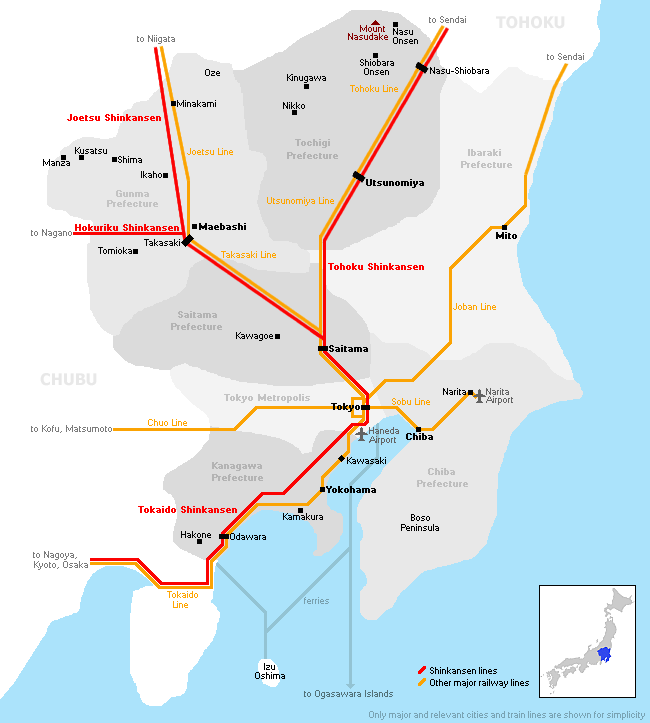
Kanto is formed by the prefectures Gunma, Tochigi, Ibaraki, Saitama, Chiba, Kanagawa and the metropolis of Tokyo in the center. The border can be drawn als followed: from Hakone in the south up northwards to Kusatsu Onsen; from here northeastward to Nasu Onsen; and from here eastbound to the coast. There are 3 shinkansen lines passing thru Kanto: the Tokaido (to Nagoya, Osaka, Kyoto), the Tohoku (to Sendai, Morioka, Aomori), the Yoetsu (to Nagano, Kanazawa). Every line starts in Tokyo. The is a Chuo Line in planning that will follow the old Nakasendo, more or less. Sightseeing Spots that must be visit are Kamakura and Nikko. Hakone, Yokohama and maybe Kusatsu onsen should be on the list to. Unfortunately all places are not located at the shinkansen tracks. Sum up (Rule: SHOULD is MUST if CAN):

  • MUST VISIT: Tokyo, Kamakura, Nikko, Hakone, Yokohama (at night)
  • SHOULD: Kusatsu Onsen, Narita
  • can: Kinugawa Onsen, Kawagoe, Kashima, Katori
  • skip it: Mito

東京 : Tokyo MUST VISIT, 3 Tage+

wikipedia DE / wikipedia EN / japan-guide

You should calculate at least 3 days to cover 90% of Tokyos basics. From my point of view a hotel close to Ueno is a good idea, because this is close to the Shinkansen, major train lines (Yamanote, Chuo, Tokaido, …) und subway lines (to Ginza, Shinjuku, Shibuya, …) and also sightseeing spots (Ueno Park, Asakusa, Akihabara, Kanda Myoin). Of course there are other good place for a base camp, like Shiodome, that are close to the Tohoku line and Yamanote. — Tokyo needs its own travel guide (like Kyoto) and therefore is not covered in this post.

Day Trips

Yokohama, Kamakura, Hakone and Nikko are easy to access. All these place are a must visit. But don’t underestimate the travelling time und that temples and parks are closen between 4pm and 5pm. Nikko and Kamakura have enough for two days but the highlighs can be visited within a day.


 鎌倉 : Kamakura, Kanagawaken — MUST VISIT, 1 Tag+

wikipedia DE / wikipedia EN / japan-guide

Kamakura was the de facto capital of Japan from 1185 to 1333. Therefore many temples and shrines can be found here. Kamakura was my frist day trip on my first Japan visit. Wow. My need really need to visit Kamakura. Kamakura offers more than you can see on one day. But, the really good stuff is doable in one single day: the temples Engakuji and Kenchoji in the North, Tsurugaoka Hachimangu and the small shopping street close to the train station in the city center, and the Hasedera temple and the great Budhha in the Kotokuin in the West. Kamakura can be reached from Tokyo by using Yokusuka line. Exit at Kitakamakura. You have to change in Ofuna if you use the Shinjuku or Tokaido line. (For Anine Fans: Elfenlied is playing in Kamakura. You will recognize many places.)


日光 : Nikko, Tochigiken — MUST VISIT, 1 Tage+

wikipedia DE / wikipedia EN / japan-guide

Nikko is a must visit that can be visited as a day trip from Tokyo. Like Kamakura and Kyoto this a place with a very high temple density. The temple and shrines of Nikko are approx. 1,2 mi away from the train station. The location is a „UNESCO world heritage“. A must visit are: Toshogu Schrein, Futarasan, Taiyuinbyo, Rinno-ji and the Shoyoen garden. At a longer stay put Chuzenko and the in winter the ski resort on the list. Nikko is accessable by JR and Tobu railway. With JR you have to change at Utsunomiya (Shinkansen stop). Be aware that getting the wrong train can end up in 3 hours travel time. The Tobu line is departing from Shinjuku / Ikebukuro oder Asakusa.


 鬼怒川温泉 : Kinugawa Onsen, Tochigiken — can, 1 Tag

Kinugawa Onsen looks a little bit run down, like the best times are over and gone. I have visited three of the available attractions: the boat cruise on the river, Tobu World Square and Nikko Edomura. The boat cruise is nice. World Square provides miniatures of sightseeing spots from all over the world, but the minatures are old and not in prefect shape. But they are the same scale so it is easy to compare. Nikko Edomura is a theme park that revives old Edo times. There are costumes for rent. Getting there takes 2 hours by Tobu Railway from Asakusa or Shunjuku/Ikebukuro.


箱根 : Hakone & Lake Ashi, Kanagawaken — MUST VISIT, 1 Tag+

wikipedia DE / wikipedia EN / japan-guide

Hakone is a day trip from Tokyo. Use the Toei-Line from Shinjuku to Hakoneyumeto; change into the tiny Tozan Line uphill; then the cog railway and the ropeway into the vulcanic field Owakudani. Then also can hike the last part of this way. The ropeway leads further to Togendai. Here boats on Lake Ashi depart for Hakonemacchi, the old toll gate that seperates Kanto and Kanzai. From here a peace of the old Tokaido  leads to Motohakone with the Hakone shrine. Busses are going back to Hakoneyumeto. There are oven more hiking trails and Onsen, but that requires a second day. Toei offers a two day Hakone Pass. (More could be found here.)


横浜 : Yokohama, Kanagawaken
MUST VISIT (at night), can visit (at day)

wikipedia DE / wikipedia EN / japan-guide

Maybe I misjudge Yokohama but at daylight it doesn’t look that fancy. At night this is different: Landmark Tower, the old ware houses in Minato Mirai and China Town illuminated nicely. The three places are connected by a promenade. My recommendation: Combine a visit to this three places with a day trip to Kamakura. Leave Kamakura before 5pm (the temples close at that time anyway) to be in Chinatown at 5:30pm. Start in Chinatown and „walk back“ to Landmark Tower. Last entrance is at 9pm. End the day at 54F with a beautiful night view of Yokohama/Tokyo. The Ramen museum is not covered by this route. It is located away at the Shinkansen station „Shin-Yokohama“.


 川越 : Kawagoe, Saitamaken — can, 1 Tag

wikipedia DE / wikipedia EN / japan-guide

This place offers a street full of old warehouses. But the mood gets disturbed by the car traffic; at least the time I visited that place. At the end of the street is the Candy Alley. On the way back you can stop at Kintain and Honmaru Goten. There are two museum too. It total it was a nice daytrip but not worth to mention. I expected more. There ist a matsuri in Kawagoe once a year, that should be visited.


水戸  : Mito, Saitamaken — skip it, 1 Tag

wikipedia DE / wikipedia EN / japan-guide

Mito has one of the three famous gardens, Kairakuen. To be honest: I was not impressed. Maybe, because I expected something different. The rest of this town doesn’t offer anything special. The train ride from Ueno station takes 66-77 minutes depending of the train. If you don’t want visit the garden, skip the place.


草津温泉 : Kusatsu Onsen, Gunmaken — SHOULD (in winter), 1/2 Tag

wikipedia DE / wikipedia EN / japan-guide

In Kusatsu kann man Onsen genießen. Im Winter ist der Ort ein bekanntes Skiresort. Touristisch gibt das Heißwasserfeld Yubatake. Gleich daneben gibt es Yumomi-Vorführungen. Der Sainokawara Park am Ortsrand führt zum Kusatsu Onsen. Die Anreise ist extrem nervig: Shinkansen bis Takasaki oder Karuizawa. Von Karuizawa fahrt ein Bus der Seibu Kogen. Von Takasaki muss man mit einem Local erst nach Naganohara-Kusatsuguchi und von der mit einem JR Bus weiter. Mit Wartezeiten kommen schnell 3 Stunden und mehr zusammen. Ich emfehle der Ort im Winter. Eine Wanderung auf den Mt. Shirane ist dann aber wegen der Schneemassen nicht möglich. Die Busverbindung nach Yudanaka ist dann ebenfalls eingestellt.


鹿嶋 : Kashima, Ibarakiken — can, 1/2 Tag

wikipedia DE / wikipedia EN / japan-guide

There are beautiful shrines in Katori and Kashima. If you practise Iaido or Kendo you might have heard of these places. You only should visit this place, if you are close by or have a personal interest. Getting there from Tokyo takes some time but is possible by train or by bus from Tokyo station. There is a local connecting Kashima and Katori.


香取 : Katori, Chibaken — can, 1 Tag

wikipedia DE / wikipedia EN / japan-guide

There are beautiful shrines in Katori and Kashima. If you practise Iaido or Kendo you might have heard of these places. You only should visit this place, if you are close by or have a personal interest. Getting there from Tokyo is possible (2 hours and changing trains several times), but it makes much more sense to plan a visit, when you are in Narita. There is a local connecting Kashima and Katori.


成田 : Narita, Ibarakiken — SHOULD, 1/2 Tag

wikipedia DE / wikipedia EN / japan-guide

Narita is good to visit on the day of arrival (departure) at (from) Narita airport or the day afterwards (before). In 2013  my flight back to Germany was at 9am. Therefore I travelled to Narita the day before. It is only a 15 minute train ride from Narita station to the airport. A lot of sightseeing spots (Bosa no mura, Onsen Yamato no Yu, Katori-Schrein), that travel guides say are located in Narita, are outside the city and therefore requires good planning. Busses go only infrequently. The city center itself offers enough attractions for a half day. From the train station (JR and Kansai are located next to each other) a shopping street (for last minutes souvenirs) with old houses leads to the Naritasan, a wide temple area. If you stay a whole day, you should consider a trip to Sawara.


am Shinkansenan Hauptlinienan Nebenstreckeabseits (Bus)
TOKYO ***Kamakura **Nikko ***Kusatsu Onsen *
SaitamaYokohama *Hakone *Manza Onsen *
Nasu-ShiobaraKawasakiKawagoeOze NP *
NaritaKinugawaShima Onsen
MitoBoso PeninsulaIkaho Onsen
Minakami OnsenKashimaTomioka
KatoriNazu Onsen
Izu Oshima
Shiobara Onsen

These places from the map are no sightseeing spots. There are places to change train or bus lines)

  • Odawara (Shinkansen, change for Hakone, there is a castle in Odwara)
  • Utsunomiya (Shinkansen, change for Nikko)
  • Takasaki (Shinkansen)
  • Chiba
  • Maebashi

Travel Guide – Tohoku

東 北 地 方 (T Ō H O K U)

wikipedia DE / wikipedia EN / japan-guide
[Deutsche Version]

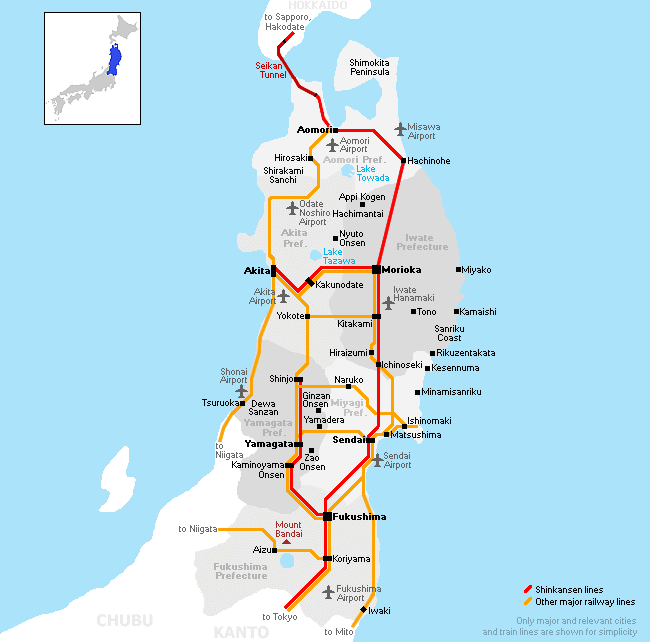
The region of Tohoku is the northern part of the Hoshu island and consists of the prefectures Fukushima, Yamagata, Miyagi, Iwate, Akita and Aomori. The border to Kanto is a east-west-line half way between Nikko and Koriyama. The prefecture of Niigate lies on the west coast and elongates up to Tsuruoka. Niigata is not part of Tohoku but of Chubu.


[I’m fan of japan-guide.com. This pic is a URL-link to the webpage]

The region is accessable by three Shinkansen lines that all start in Tokyo: The Tohoku Shinkansen is going up to Aomori in the North and there becomes the Hokkaido Shinkansen. In Fukushima the Yamagata Shinkansen seperates from the main line. In Morioka the Akita Shinkansen seperates.

  • Tokyo – Shin-Aromori : 190-205 minutes (Hayabusa)
  • Tokyo – Shinjo : 210-220 minutes
  • Tokyo – Akita : 225-235 minutes

In Tohoku are several places that are worth a limit; e.g. Matsushima, Hiraizumi, Kakunodate. But many places are unknown to me. (Looks like I have a plan for 2018). For a first trip I recommend Kanto, Chubu and Kansai because there are big numbern. Tohoku is something for the second trip. Sum up (Rule: SHOULD is MUST if CAN):

  • MUST VISIT: Matsushima, Kakunodate
  • SHOULD: Sendai, Hiraizumi, Aizu-Wakamatsu, Yamadera
  • can: Morioka, Kitakami
  • skip it: Naruko (solange Schlucht geschlossen)

盛岡 : Morioka, Iwateken — can, 1 Tag

wikipedia DE / wikipedia EN / japan-guide

Morioka has a few sightseeing spots: the castle ruins, a tree (Ishiwarikazura) that split a rock and is now a national treasure. The highlight is Hoon-ji, a temple that displays 500 small Buddha statues (and also Marco Polo and Kublai Khan).  Nothing justifies a longer stay. Make Morioka a stop between to hotels. Exception: Cherry blossom.


仙台 : Sendai, Miyagiken — SHOULD, 1 Tag

wikipedia DE / wikipedia EN / japan-guide

Sendai is a place to visit. With a good plan, discipline and the help of the Loopli-bus a visit of all important attractions is possible in one day: Zuihoden Mausoleum, Osaki Hachimangu und Rinno-ji. The castle ruins are optional. With Sendai as a base camp daytrips are possible to Hiraizumi, Kitakami and also Yamadera. Wakamatsu is a little bit to far away (I tried). Naruko is not worth a visit at the moment. The famous gorge is still closed (situation in 2016).


松島 : Matsushima, Miyagiken — MUST VISIT, 1 Tag

wikipedia DE / wikipedia EN / japan-guide

The landscape is an eyecatcher. It is one of the three famous sceneries. Visit also the temples Zuigan-ji and Entsu-in. If you stay in Matsushima you can visit Sendai as a daytrip. But I recommend Sendai as a base camp because of its location at the Shinkansen line.


北上 : Kitakami, Iwateken — can, 1/2 Tag

wikipedia DE / wikipedia EN / japan-guide

This place is interesting for its open-air museum that features old japanese houses from different eras. The Tenchichi-Park is a cherry blossom spot. Kitakami is a good stop-over because is it located at the shinkansen tracks. But if you don’t stop here you will not miss that much. THerefore is is a „can visit“.


平泉 : Hiraizumi, Iwateken — SHOULD, 1 Tag

wikipedia DE / wikipedia EN / japan-guide

In Hiraizumi kann man fast einen ganzen Tag verbringen. Nahe am Bahnhof gibt es den Tempel Motsuji. Von hier aus gibt es einen netten Wanderweg den Berg hinauf und durch einen kleinen Wald zum weitläufigen Areal des Chusonji. Weitere Attraktionen sind etwas entfernt, aber machbar. Alternativ kann man versuchen, Kitakami zu besuchen. Für Hiraizumi muss man in Ichinoseki (2 Stationen) oder Kitakami (6 Stationen) vom Shinkansen in einen Local der Tohoku Main Line wechseln.


会津若松 : Aizu-Wakamatsu, Fukushimaken — SHOULD, 1 Tag

wikipedia DE / wikipedia EN / japan-guide

Aizu-Wakamatsu can be reached by travelling over Koriyama (or Niigata, but this takes even more time). The local are travelling quite a time. If you are on a tight schedule, you have to takes this into consideration. Beside the castle — that is a beautiful cherry blossom spot by the way — the city offers an old samurai residence, a pagoda with a helix staircase inside. There is a bus between the sightseeing sports, so it is possible to cover all the major spots within a day.


角館 : Kakunodate, Akitaken — MUST VISIT, 1 Tag

wikipedia DE / wikipedia EN / japan-guide

The old city center provides many old samurai houses along a street. Many of the places were converted into a museum or a craftsman shop  or are open for visitors. You can easily spend a whole day here. You don’t need to hurry. The city is located between Morioka and Akita at the Akita Shinkansen Line. Note: Kakunodate is part of Semboku. Maybe this helps to google more information.


鳴子温泉 : Naruko Onsen, Miyagiken — skip it, 1 Tag

wikipedia DE / wikipedia EN / japan-guide

Naruka is far away from every major travelling route and doesn’t offer that much: a gorge, a geyser and the „cold hell“. The 2,km long gorge is closed since a taifun in 2014. Naruko lost its main attraction. The cold hell is a short walking trail in a valley surrounded by trees. Boiling (!) Water is gushing from tiny springs left and right from the river.

The name Naruko is derived from naru koe no sato (鳴る声の郷) that translates to „place of the trembling sound“. The city is on the northern slope of a lava dome in the center of the caldera of the Naruko vulcano. The vulcano is labeled as „active“. The last eruption in 837 resulted in the name of the place and hot, boiling water running down the slopes for days.


山寺 : Yamadera, Yamagataken — SHOULD, 1/2 Tag

wikipedia DE / wikipedia EN / japan-guide

Yamadera is a famous temple located in a town with the same name, that was founded 1100 years ago. The temple at the side and at the top of a steep mountain. 1000 steps leads up to the main hall. The temple is the only place that is interesting to visit in this town, beside a small museum. Considering the travel time the temple is only worth to be a day trip from Sendai or Yamagata.


My idea for Tohoku in 6 Days:

  • (Day 0: Travel to Sendai)
  • Day 1: Sendai
  • Day 2: Matsushima (day trip)
  • Day 3: Hiraizumi (daytrip)
  • Day 4: Wechsel nach Morioka (and visit of Morioka)
  • Day 5: Kakunodate (day trip)
  • Day 6: Travel to the next hotel with stop-over in Kitakami

Not in the plan: Yamadera, Naruko und Aizu-Wakamatsu, and all places that I haven’t visited yet.


am Shinkansenan Hauptlinienan Nebenstreckeabseits (Bus)
Kakunodate *Yamadera **Lake Towada *Nyuto Onsen ***
SendaiAizu-Wakamatsu *Bandai *Dewa Sanzan **
KitakamiMatsushima *Ochijuku *Hachimantai *
MoriokaHiraizumi *Appi Kogen *Shirikami Sanchi
AomoriHirosaki *"Sanriku-Küste" *Zao Onsen *
FukushimaNarukoTonoGinzan Onsen *
AkitaIshinomakiShimokita Peninsula *
Kaminoyama OnsenYokote
YamagataTsuruoka
Iwaki

There are also city mentioned in the map that are no sightseeing spots. These are transfer points between train lines.

  • Koriyama (change here for Aizu-Wakamatsu)
  • Ichinoseki (change here for Hiraizumi)
  • Hachinohe
  • Yamagata (change here for Yamadera)
  • Shinjo (terminal of the Yamagata-Shinkansen)

Zeitrechnung in Japan (Nengo)

In Japan laufen die Uhren anders! Damit wäre alles gesagt. Öffnungszeiten gehen schon mal bis 29 Uhr. Sommerzeit gibt es nicht. Datumsangaben sind mal wie in Deutschland geschrieben (Tag-Monat-Jahr), mal in anderer Richtung (Jahr-Monat-Tag). Am schwierigsten ist aber für Nichtjapaner das Rechnen in Nengo (Ära). Dies ist eine Rechnung in Jahren der Regentschaft eines Kaisers.

Der Kaiser wählt bei Thronbesteigung den Namen der Nengo. Es ist seine Regierungsdevise. Nach seinem Tod wird er unter dem Namen der Nengo in die Geschichtsbücher eingehen. Beispiel: Derzeit schreiben wir das Jahr 2017. In Japan ist dies Heisei 29. Kaiser Akihito bestieg 1989 den Thron. Damit war dieses Jahr Heisei 1. Gleichzeitig war es Showa 64, das 64. der Regentschaft von Kaiser Hirohito. Nach seinem Tod wird Kaiser Akihito als Heisei-Tenno in den Geschichtsbüchern gelistet.

Die Nengorechnung findet sich unter anderem als Jahresangabe auf den japanischen Münzen. Die Nengo seit der Meiji-Restauration sind:

  • 平成 = Heisei (Frieden überall): 1989 – (läuft noch)
  • 昭和 = Showa (erleuchteter Frieden): 1926 – 1889
  • 大正 = Taisho (große Gerechtigkeit): 1912-1926
  • 明治 = Meiji (aufgeklärte Herrschaft): 1868 – 1912

Eine Liste aller Nengo findet ihr hier: Nengo auf Wikipedia.

Das System der Äranamen wurde im Jahr 645 von den Chinesen übernommen. Der erste Äraname war Taika (大化) und eine Folge der danach benannten Taika-Reform. Allerdings wurden die Nengo unregelmäßig präzise und konsequent benutzt. Teilweise hatte ein Kaiser mehrere Nengo ausgerufen. Seit der Heian-Zeit ist der Name des Nengo von konfuzianischem Gedankengut geprägt. Es gibt Devisen wie Daido (Große Gleichheit) und Konin (Weite Gerechtigkeit).

Nengonamen bestehen aus zwei Kanji. Nur in der Nara-Zeit wurden 4 Kanji verwendet. Heisei ist die 247. Nengo. Dabei komme nur 72 verschiedene Kanj zum Einsatz. Von denen wiederum kamen 30 nur ein Mal zum Einsatz. Die verbleibenden 42 Kanji wurde also immer wieder in verschiedener Kombination benutzt.

Die Umrechnung von Nengo in westliche Jahreszahlen ist vor 1872 kompliziert, da der chinesische Kalender zur Anwendung kam. Womit der 12 Monat eventuell der 1. Monat des Folgejahres wird. Beispiel: Tokugawa Ieyasu wurde am 26. Tag des 12. Monats des 11. Jahrs der Tembun-Ära geboren (天文11年12月26日). Nach einfacher Umrechnung ergibt sich der 26.12.1542. Aber es ist eigentlich der 31.01.1543.

Hinweis: Nach japanischer Etikette wird amtierende Kaiser weder Kaiser Akihito (Geburtsname) genannt, noch Heisei-Tenno (posthumer Name). Er heißt schlicht Tenno Heika (天皇陛下, seine Majestät der Kaiser). Inoffiziell wird er auch Kinjo Tenno (今上天皇, derzeitiger Kaiser) genannt.

[Stand 08/2017]

Zeitrechnung in Japan (Epochen)

In Japan laufen die Uhren anders! Damit wäre alles gesagt. Öffnungszeiten gehen schon mal bis 29 Uhr. Sommerzeit gibt es nicht. Datumsangaben sind schon mal rückwärts geschrieben (2017-09-02 oder nur 09-02) oder verwenden Nengo (Heisei 18, 10-19 = 19.10.2006).

Spätestens im Reiseführer wird man mit Nara-Zeit und Edo-Zeit konfrontiert. Dies ist eine Einteilung der japanischen Geschichte, nicht ganz unähnlich unserer Einteilung wie z.B. Vormärz, 30-jähriger Krieg, Reformation, … Unterschied ist die Namensgebung. Bei uns sind es meistens Kaiser oder Herrscherfamilien (Karolinger, Staufen, …). Die japanische Geschichtseinteilung orientiert sich grob an der Hauptstadt (Asuka, Nara, Edo, …).

Die Zeiten in Japan heißen Jidai (時代). Die eingebauten Links führen zu Wikipedia. Hier eine Übersicht der japanischen Geschichte:

  • Frühe Geschichte
    • vor 10.000 v. Chr. : Altsteinzeit
    • 10.000 — 300 v. Chr. : Jōmon-Zeit
    • 300 v. Chr — 300 n. Chr : Yayoi-Zeit
  • Altertum
    • 300 — 352 : Kofun-Zeit
    • 352 — 710 : Asuka-Zeit
    • 710 — 794 : Nara-Zeit
    • 794 — 1185 : Heian-Zeit
  • Mittelalter
    • 1185 — 1333 : Kamakura-Zeit
    • 1333 — 1568 : Muromachi-Zeit
    • 1568 — 1600 : Sengoku-/Momoyama-Zeit
  • Edo-Zeit
    • 1600 — 1868 : Tokugawa-Zeit
  • Kaiserreich
    • 1868 – 1937 : Meiji-Zeit (Orientierung am Westen)
    • 1937 – 1945 : Imperialismus und WWII
    • 1989 – heute : parlament. Demokratie

Mit Beginn der Meiji-Restauration gibt es in diesem Sinne keine neue Epoche mehr. Hier empfiehlt sich ein Unterteilung in Nengo oder in die Zeiten von Imperialismus, 2. Weltkrieg und Nachkriegszeit. WICHTIG: Dies hier vorgestellte Einteilung für die Zeit nach 1868 ist meine Einteilung.


Fokus der nachfolgenden Einteilung sind die Einordnung von Bauten (Burgen, Tempel, Schreine, …) und den geschichtlichen Kontext, der hier aus diesem Grund nur ganz, ganz grob angerissen wird.

  • < 10.000 BC : Altsteinzeit
    • Einwanderung von Völkern aus Sibirien und Korea
  • 10.000 BC — 300 BC : Jomon
    • Jäger und Sammler; Beginn Landwirtschaft
    • Keramikfunde mit „Schnurmuster“; Dogu Tonstatuen
  • 300 BC — 300 : Yayoi
    • Die Epoche ist benannt nach Tonfunden in Tokyo, Yayoi;
    • Metallverarbeitung; Ackerbau, Sesshaftigkeit
    • Einwanderung aus Korea; Bildung von Clans
    • Pfahlbauten mit Giebel- und/oder Walmdach
    • Dolmen- und Megalithgräber
      • Ursprungszeit des Ise-Schreins
      • Ursprungszeit des Sumiyoshi Taisha, Osaka
  • 300 — 552 (538) : Kofun (manchmal auch Yamato-Zeit)
    • benannt nach den „Schlüssellochgrabanlagen“
    • Feudalgesellschaft; Großfamilien; Herrscher: Yamato-Familie
      • Grabanlagen (südlich von Osaka, bei Nara, …)
  • 538 (592) — 710 : Asuka
    • benannt nach der Hauptstadt
    • Buddhismus kommt nach Japan
    • Herscher Soga veröffentlich die „17 Artikel“
    • politische Machtkämpfe ab 622; Aufstieg der Fujiware ab 645; Taika-Reform 646: zentralisierter Beamtenstaat
      • 607: Horyuji-Tempel, Nara
      • 609: Asakusa Daibutsu, Asakusa-dera
      • 645: Senso-ji in Asakusa, Tokyo
  • 710 — 794 : Nara
    • benannt nach der Hauptstadt
    • Friedenszeit, kulturelle Blüte; kultureller Austausch mit China (Tang-Zeit); Übernahme der Kanji aus China
    • Verwaltung nach chin. Vorbild (Ritsuryo)
    • Kampf zwischen Fujiwara und buddhistischen Mönchen
    • Etablierung des Buddhismus / Synkretismus mit Shinto
    • einziger internat. Hafen ist Hakata; Sonderverw.zone Dazaifu
      • jap. Literatur: Kojiki (712), Nihonshoki (720)
      • Aufbau eines Fernstraßensystems (Tokaido, Nakasendo)
      • 751: Daibutsu im Todai-ji, Nara
  • 794 — 1185 (1192) : Heian
    • benannt nach der Hauptstadt (Heian = Kyoto)
    • Kammu-Tenno, Fujiwara
    • Hochzeit der Dichtkunst und Literatur: Genji Monogatari; Entwicklung des Hiragana
    • Kampf zwischen Genji-Clan und Heike-Clan; Beginn des Zerfalls der zentralstaatlichen Ordnung: Tarai schlagen Minamoto (Heiji-Rebellion, 1160); Minamoto schlagen Taira vernichtend (Gempai-Krieg, 1185)
      • 816: Erschließung von Koyasan durch Kukai
      • 888: Toji (Holzpagode, Neubau von 1644)
      • 998: Byodo-in; Uji, Kyoto-ken (Phönixhalle, 10yen-Münze)
      • 1168: Itsukushima Jinja, Miyajima
  • 1185 (1192) — 1333 : Kamakura
    • benannt nach der Hauptstadt
    • Yoritomo begründet das Shogunat; Beginn Militärverwaltung (1192) / Bakufu; Aufstiegs des Kriegeradels (Samurai)
    • Hojo kommen an die Macht
    • Handel mit China (Song-Dynastie)
    • versuchte Mongoleninvasion in 1274 und 1281 (Kamikaze)
    • Zeit der Nordhöfe (Kyoto) und Südhöfe (Yoshino)
    • Vernichtung der Hojo durch Ashikaga und Nitta (1333)
      • 1243: Gründung Eihei-ji in Fukui
      • 1252: Daibutsu im Kotoku-in, Kamakura
  • 1333 — 1568 (1477) : Muromachi (Ashikaga-Zeit)
    • benannt nach einem Stadteil von Heiankyo
    • Errichtung eines neuen Shogunats durch die Ashikaga
    • Kemmu-Restauration
    • Zerfall des Shogunats durch Oninkrieg und fast vollständige Zerstörung der Hauptstadt als Folge (1467-1477)
      • 1346: erste Burg Himeji-jo
      • 1397: Kinkaku; Rokuon-ji, Kyoto
  • (1477) — 1573 : Sengoku (Zeit der Streitenden Reiche)
    • Einführung von Feuerwaffen
    • Zerfall des Reiches in fast 200 Territorien
    • Namen: Oda Nobunaga, Toyotomi Hideyoshi, Tokugawa Ieaysu
    • Schlacht von Okehazama (1568)
      • 1482: Ginkaku; Kyoto (silberner Pavillion)
      • 1499: Ryoan-ji; Kyoto (berühmt für den Steingarten)
  • 1568 (1573) — 1600 : Azuchi-Momoyama
    •  Schlacht von Nagashino (1575); Beginn Einigung der Reiche
    • Schaffung von Provinzen, Lehenstreue; Straßenbau; Vereinheitlichung der Währung, Maße und Gewichte schafft Voraussetzungen für Handel und Wirtschaft
    • Eroberungskrieg in Korea (1591-1598)
    • Tod von Tokugawa Ieyasu (1598); Machtkämpfe und Schlacht von Sekigahara (1600); Tokugawa gewinnen
      • 1576-1579: Bau der Festung Azuchi (namensgebend)
      • 1591: Nishi Hongan-ji; Kyoto
  • 1600 — 1868 : Tokugawa / Edo
    • Tokugawa-Shogunat; Verlegung Hauptstadt nach Edo
    • Herschaft durch Shogun und seiner Daimyos (Bakufu)
    • 4-Ständes-Syste (Krieger, Bauern, Handwerker, Kaufleute)
    • Urbanisierung; Entstehung bürgerliches (Stadt)Leben
    • konservative Werte (Zen, No-Theater, Teezeremonie, …)
    • Abschließung Japans (Sakoku, 1630) nach außen bis Ankunft von Admiral Perry und gewaltsame Öffnung Japans (1853)
    • Senno-joi-Bewegung; beendet das Shogunat
      • um 1600: jetzige Form der Trommelbrücke des Sumiyoshi Taisha, Osaka
      • 1601: Ni-jo, Kyoto
      • 1633: Kiyomizudera Gebäude (Tempel seot 798); Kyoto
      • 1673: Kintai-Brücke, Iwakuni
      • 1×16: Himeji-jo in ihrer heutigen Form
      • 1707: letzter Ausbruch des Fuji
      • Altstadt von Kurashiki
  • 1868 — 1937 : Kaiserreich (Meiji, Taisho, Showa)
    • Meiji-Restauration: Entmachtung des Kriegeradels und Ausrichtung Japans an „westlichen Werten“: Abschaffung des Ständesystem, Abschaffung des Feudalsystems, Schulpflicht, Wehrpflicht, Kleidung, Verfassung, Übernahme des dt. BGB, …
    • Boshin-Krieg: letzte Auflehnung des Shogunats/Samurai
    • Japan ist nun konstitutionelle Monarchie
    • aufkommender Imerialismus und Kolonialismus: 1895 chin.-jap. Krieg, 1905 russ.-jap. Krieg; 1910 Anektierung Korea
      • Kanto-Erdbeben 1923
  • 1937 — 1952 : Pazifikkrieg / Besatzungszeit (Showa)
    • zweiten chin.-jap. Krieg (1937, theoretischer Beginn des WWII)
    • Pearl Harbor; Eintritt USA in den Pazifikrieg (1941)
    • Atombombenabwürfe und Kriegsende (1945)
    • Ende der Besatzungszeit und Wiederaufbau Japans (1952)
  • 1952 — heute: parlamentarische Demokratie (Showa, Heisei)

    • parlamentarische Demokratie; Kaiser hat nur repräsentative Aufgaben
    • wirtschaftlicher Wiederaufstieg und steigenden Wohlstand
    • Bubbleeconomy (Sepktulationsblase, ca. 1985 bis 1990)
    • Verlorenes Jahrzehnt (1990-2000)
    • 1993: Kobe-Erdbeben; 2011 Tohoku-Erdbeben / Fukushima
      • ab ca. 1952: Omoide Yokocho
      • 1956: Tsutenkaku, Osaka (jetzige Bauform)
      • 1958: Tokyo Tower
      • 1964: Shinkansen
      • 1988: Seto-Ohashi-Bridge
      • 1993: Rainbow Bridge
      • 2012: Tokyo Sky Tree

Die Liste werde ich nach und nach erweitern und mit Links nach wikipedia und japan-guide versehen.

[Stand 08/2017]