Travel Guide – Kyushu

九 州   (K Y Ū S H Ū)

wikipedia DE / wikipedia EN / japan-guide
[Deutsche Version …]

The 九 (kyuu = nine) 州 (shuu = province) are building the southernmost of the four main islands of Japan. On Kyuhsu I only visited a few places. 2006 I started with Beppu and Aso (vulcano). In 2016 I added Nagasaki, Fukuoka/Hakata, Dazaifu, Kumamoto, Yufuin and Kurokawa to the list. But, the island Kyushu in total only is a „should visit“.

[Ich bin ein Fan von japan-guide.com. Das Bild ist ein URL-Link]

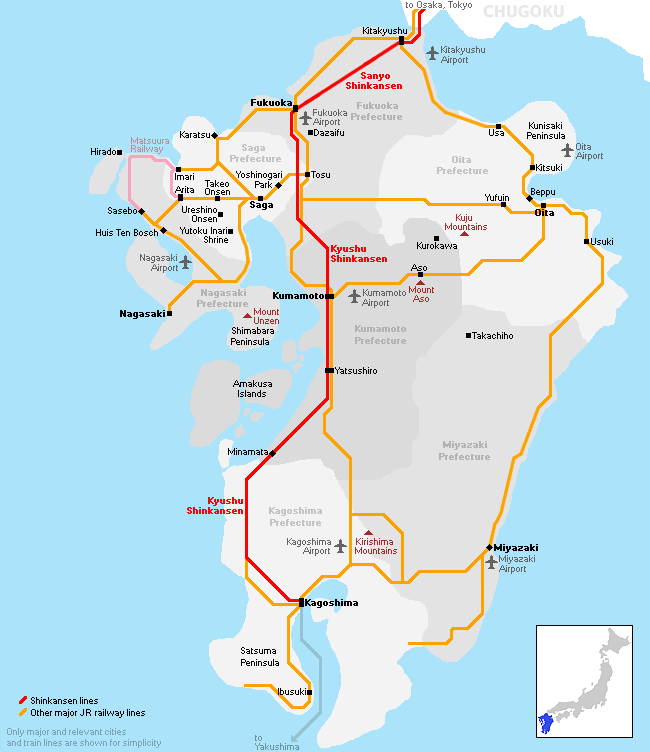
The problem with Kyushu is not the limited amount of temples, castles and shrines. It is to get there. All international flights starting in Europe are going over Osaka and Tokyo. And even the shinkansen needs a whole day. Therefore you should a visit to Kyushu as a complete trip and not split up Kyushu into different journeys. Sum up (Rule: SHOULD is MUST if CAN):

  • MUST: Nagasaki, Kumamoto
  • SHOULD: Beppu, Fukuoka/Hakata, Dazaifu, Yotoku Inari Jinja, Kurokawa
  • can: Vulkan Aso, Huis Ten Bosch, Yufuin

別府 : Beppu, Oitaken — SHOULD, 1 day

wikipedia DE / wikipedia ENG / japan-guide

Beppu is famous for it „Eight hells“. These are eight onsen (hot water spring) that are not siutable for bathing. Each hells is different from the others. The are nice, and you should visit them, but the are not that aweson that the are worth the trip ti Kyushu. Because on the location Beppu is not suitable for daytrip. Even Fukuoka is to far away.


阿蘇山 : Vulcano Aso, Kumamotoken
can, 1 Tag
(MUST VISIT for vulcano enthusiast)

wikipedia DE / wikipedia ENG / japan-guide

Aso offers you a view into the crater, which is filled with a lake, in that the blue water is boiling by the heat coming from below. Getting there from Beppu is nightmare. Don’t do this mistake, like I did. Plan a trip starting in Kumamoto. But there is still one risk: The crater is often closed for tourist due to higher activity in release of toxic gas. If this happens, there is no plan B. There is nothing going on in the village and you will spend your day in waiting for the next train back or the crater to open.


長崎 : Nagasaki, Nagasakiken — MUST VISIT, 1 day

wikipedia DE / wikipedia ENG/ japan-guide

The temples and shrines, Glover Garden and also Oura Church are definately worth a visit. You can skip the peace memorial park. Distances in Nagasaki are not the far, so you can cover everything with a little bit of planning. I recommend to stay at least one night. China Town at daylight is boring. And there is a nearby mountain that provides a good night view of the city, like in Hakodate.


ハウステンボス : Huis Ten Bosch, Nagasakiken — can, 1/2 day

wikipedia DE / wikipedia EN / japan-guide

Huis Ten Bosch is far away from Nagasaki. If you don’t want to see a japanese version of the Netherlands, you can skip it. But the light installation are worth a visit. I was happy to made a stop there.


福岡/博多 : Fukuoka/Hakata, Fukuokaken — SHOULD, 1 day

wikipedia DE / wikipedia ENG / japan-guide

Fukuoka/Hakata has some nice sightseeing spots, but it is not like you miss something special. But Fukuoka/Hakata is transportation hub with connection to the shinkansen network and an airport that makes Fukuoka/Hakata a good base camp. Two more reasons for that place is the proximity to Dazaifu an the Yatai at night.


太宰府 : Dazaifu, Fukuokaken– SHOULD, 1 day

wikipedia DE / wikipedia EN / japan-guide

Dazaifu is small and can be visited within a half day easily. There is one shrine and a temple with a beautiful garden next to it. There are two more old and small temples that are a mile away. You can skip the „government ruins“. With the shopping street between the shrine and the train station the tourist thing is complete.


祐徳稲荷神社 : Yutoku Inari Jinja, Sagaken — SHOULD, 1/2 day

wikipedia DE / wikipedia EN / japan-guide

The shrine is far away from Nagasaki and Fukuoka. Luckily the train station is serviced by the Ltd. Express. But it is a long way from the train station to the shrine (over two miles). You need a taxi. There busses but I don’t know the timetable.


湯布院 : Yufuin, Oitaken  — can, 1 day

wikipedia DE / wikipedia EN / japan-guide

A small onsen town close to Beppu. But to be honest, Kurokawa is smaller and much prettier. In the other hand, it is easier to get to Yufuin an even easier to go to Beppu.


黒川 : Kurokawa, Kumamotoken — SHOULD, 1 day

wikipedia DE / wikipedia EN / japan-guide

This a small, nice onsen town. But it is very difficult to get there. It is in the middle of nowhere. There are only two highway busses a day. Or you rent a car. But I really recommend at least a day trip if you are an onsen enthusiast. Try to stay over night. It is really decellerating. Because all you can do is to visit an onsen and do nothing else.


熊本 : Kumamoto, Kumamotoken — MUST VISIT, 1 day

wikipedia DE / wikipedia ENG / japan-guide

My knowledge of Kumamoto is limited to the castle, that was closed for visitors because of the damages caused by the April 2016 earthquake. But so far Kumamoto is a place the you should visit.


am ShinkansenHauptstreckeNebenstreckeabseits (Bus / Boot)
Kumamoto *Nagasaki **Vulkan Aso *Yakushima ***
Fukuoka/Hakata *Yoshinogari Park *Yufuin *Kurokawa Onsen **
Kagoshima *Beppu *Huis Ten Bosch *Amami Oshima **
MinamataOitaYutoku Inari Jinja *Takachiho *
KitakyushuUsaDazaifu *Udo Shine *
KitsukiKaratsuKirishima *
UsukiTakeo OnsenSatsuma Peninsula *
MiyazakiAritaKunisaki Peninsula *
ImariShimabara Peninsula
IbusukiKirishima Mountains
Ureshino Onsen
Amakusa Island
Kuji Mountains
(Vulkan) Unzen
Hirado

Listed in the map but no sightseeing spots. There are places to change train or bus lines)

  • Yatsushiro (connection point Shinkansen – Hauptlinie)
  • Tosu
  • Saga
  • Sasebo (connection point JR – Matsuura Railway)
  • Nagasaki Airport, Fukuoka/Hakata Airport
  • Oita Airport, Kagoshima Airport, Kumamoto Airport, Kitakyushu Airport
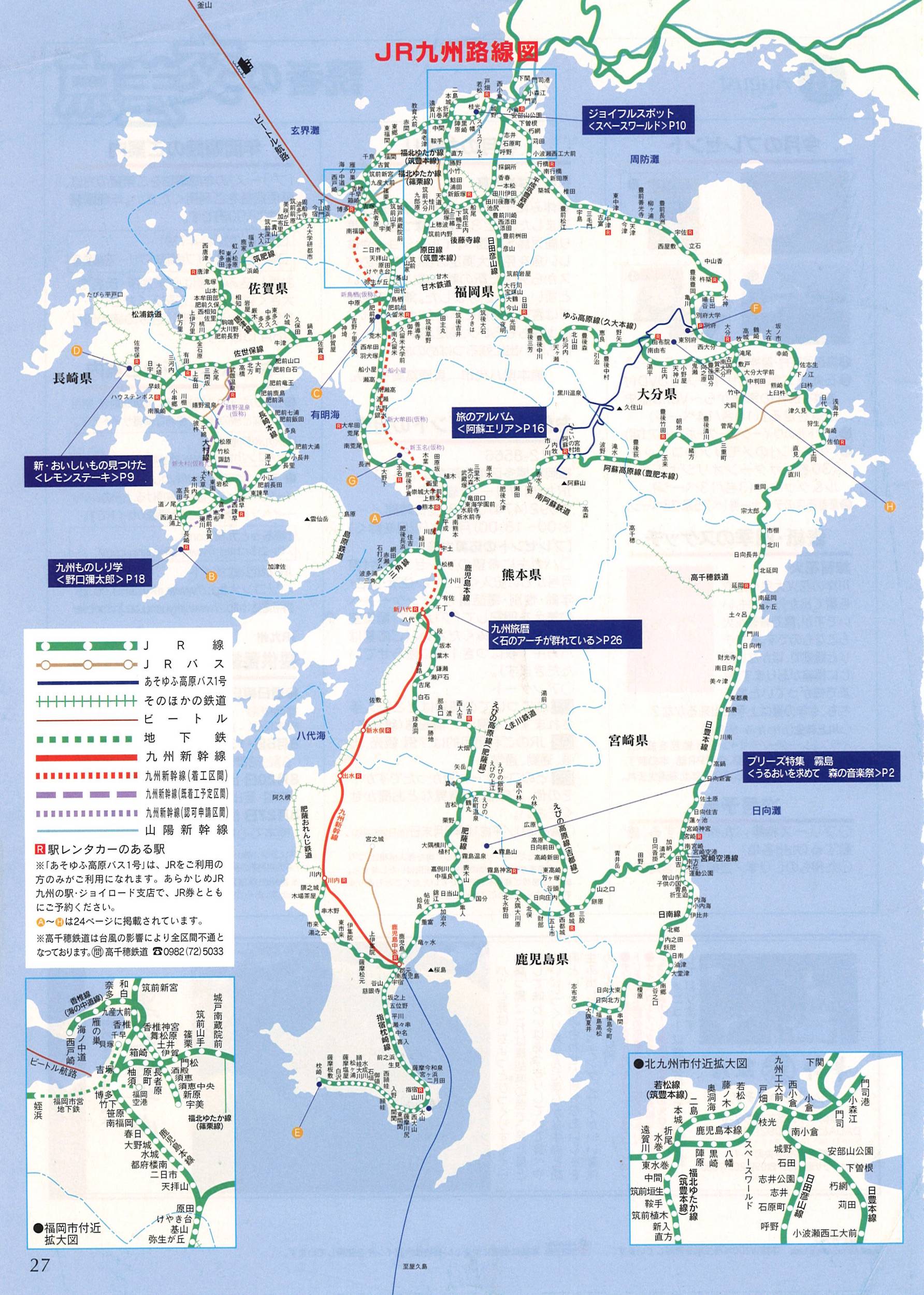
JR Kyushu

Travel Guide – Shikoku

四国   (S H I K O K U)

wikipedia DE / wikipedia EN / japan-guide
[Deutsche Version …]

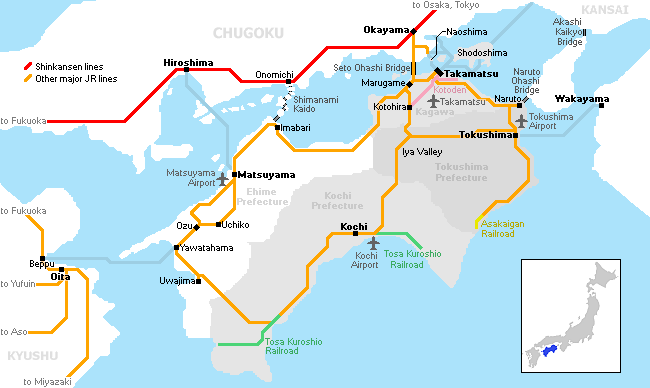
The island of the 四 (shi, yon = four) 国 (koku, kuni = country). The name referes to the former provinces Iyo, Sanuki, Awa and Tosu. Today Shikoku consists of four prefectures: Ehime, Kagawa, Tokushima and Kochi. The old names are still present in many places. The official name of the Ozu train station is Iyo-Ozu. In the Iya valley you can order Sanuki Udon.


[Ich bin ein Fan von japan-guide.com. Das Bild ist ein URL-Link]

Shikoku has no Shinkansen train station. The only connection to Honshu island by train is thru the Seto-Ohashi-Bridge. Beside that there are two car bridges and several ferry boats. The train network of Shikoku is completely or partially covered by several different Japan Rail Passes. But check out the travel times first. Without the Shinkansen everything takes a little bit longer than expected. And there is not a train going every 15 minutes. The clocks on Shikoku are ticking a little bit slower. (Rule: SHOULD is MUST if CAN.)

  • MUST visit: Matsuyama mit Dogo Onsen
  • should visit: Ozu, Uchiko, Kotohira, Iyatal (?)
  • can visit: Takamatsu, Bando, Marugame (?)
  • skip it: Tokushima

As a crash course of Shikoku I recommend Dogo Onsen with a trip to Ozu and Uchiko, and to Takamatsu with a trip to Kotohira and Marugame. More information follow as soon if I have them.


徳島 : Tokushima, Tokushimaken — skip it

wikipedia DE / wikipedia EN / japan-guide

There is nothing in Tokushima that is worth a visit, with one exception: the most famous dance festival of Japan: the Tokushima Awa Odori. If that is reason enough to travel to Tokushima is your decision alone. The Koenji Awa Odori close to Tokyo is a good alternative. Tokushima has a ferry connection to Wakayama (Kansai) and is a hub in the Shikoku train networt. But for me it is still no option for a base camp.


坂東 : Bando, Tokushimaken — can, 1/2 Tag

In Bando located is the first temple of the 88 temple pilgrimage. Temple #2 and #3 are right around the corner. Temple #1 is nice but not worth the effort, if your not going to start the pilgrimage. You easily spend half a day for the visit. Bando train station is only serviced by one train an hour or even less. It takes you one hour or more to travel from/to Tokushima, that is only 6 train stations away. Just skip the temple and safe some time.


丸亀 : Marugame, Kagawaken — can, 1/2 Tag

wikipedia DE / wikipedia EN / japan-guide

In Marugame are the ruins of the castle (walls and one watch tower). The view is awesome. You can see the complete Seto Ohashi bridge. There are boats leaving for the islands. Something I didn’t do and therefore can not write about. The visit of the castle is a detour of 2 hours. Marugame is the train station where the trains over the Seto Ohashi bridge depart.


琴平 : Kotohira, Kagawaken — SHOULD, 1 Tag

wikipedia DE / wikipedia EN / japan-guide

Kotohira is a small town where nothing happens. But there is an old kabuki theatre and the shrine Kompirasan. Both really worth a visit. You can explore the complete town in less than a day. There is a direct train connection to Takamatsu by the Kotoden company. The JR is going over Marugame. With good planned you can visit Kotohira and Marugame within one day.


高松 : Takamatsu, Kagawaken — SHOULD, 1-2 Tage

wikipedia DE / wikipedia EN / japan-guide

Takamatsu is a harbour city in the northeast of Shikoku. The castle site is converted into a nice park. In the south is the famous Ritsuri Koen. Other sightseeing sports are outside the city. Therefore I didn’t visit them. So far Takamatsu is a „should visit“. Takamatsu is tactical place to stay because of its location in the railroad network. (Even if I decided to stay in Kotohira).


祖谷渓 : Iyadani, Tokoshima — can, 1 Tag

wikipedia DE / wikipedia EN / japan-guide

The Iya Valley has the Kazurabashi. A bridge with a certain adrenalin kick. Beside that, the Valley is a really remote place but a very good place for hiking. To get from A to B you need a rental car (you cannot rent at the place) or a lot of money for taxi rides. Buses are going very infrequently. Believe me. My sum up: If you don’t have car and are not into hiking, think about a visit twice.


松山 : Matsuyama, 道後温泉 : Dogo Onsen,
Ehimeken
— MUST VISIT, 1 Tag

Matsuyama: wikipedia DE / wikipedia EN / japan-guide
Dogo Onsen: wikipedia DEwikipedia EN / japan-guide

The castle of Matsuyama is a must visit. Beside the castle there is nothing else in Matsuyama but there is a tram to Dogo Onsen. The Dogo Onsen Honkan really is an eyecatcher. The train station is also a nice spot, also is the shrine. You can visit all of it within a day. But consider that getting there takes some time (Matsuyama-Takamatsu takes 3 hours). I recommend Dogo Onsen as a base camp. With a ferry boat to Hiroshima there is a nice travel option too.


大洲 : Iyo-Ozu, Ehimeken — SHOULD, 1/2 Tag

wikipedia DE / wikipedia EN / japan-guide

The castle of Ozu is worth a visit. The castle was reconstructed in 2004 with traditional craftmanship and not by using concrete, like at other reconstructed castles. Garyo Sanso is the second sightseeing spot. You can skip the old town. It is not that fancy. Ozu and Uchiko can be visited within one day if you stay in Matsuyama. But it needs some planning (of the train connections).


内子 : Uchiko, Ehimeken — SHOULD, 1/2 Tag

wikipedia DE / wikipedia EN / japan-guide

Uchiko hosts an old kabuki theatre, like Kotohira does. Beside that there an old pharmacy building that is converted into a small museum. There is a street with only old, traditional houses. This really is a nice spot but do not expect to much. At the end of the street is a small temple. Ozu and Uchiko can be visited within one day if you stay in Matsuyama. But it needs some planning (of the train connections). If time is short you shoud priorize Uchiko.


Hautplinie (Nord)NebenlinieInseln
Matsuyama *Kotohira *Naoshima **
Uchiko *Iya Tal (Eingang) *Shimanami Kaido
Ozu *Kochi *Shodoshima
Takamatsu *Naruto
Marugame
Tokushima
Uwajima

Listed in the map but no sightseeing spots. There are places to change train or bus lines)

  • Imabari (start of the Shimanami Kaido biking trail)
  • Yawatahama (ferry boat to Kyushu)
  • Kochi Airport, Matsuyama Airport, Takamatsu Airport, Tokushima Airport

Travel Guide – Chugoku

中 国 地 方   (C H Ū G O K U)

wikipedia DE / wikipedia EN / japan-guide
[Deutsche Version]

The region of Chugoku is often missed when focussing on Kanto and Kansai. This is a mistake. Beside Hiroshima and Miyajima there are some places that are really worth a visit and some are a must-visit; maybe not on the first trip to Japan, but definately for the second or third.


[I’m a fan of japan-guide.com. This pic is a URL-Link to the website.]

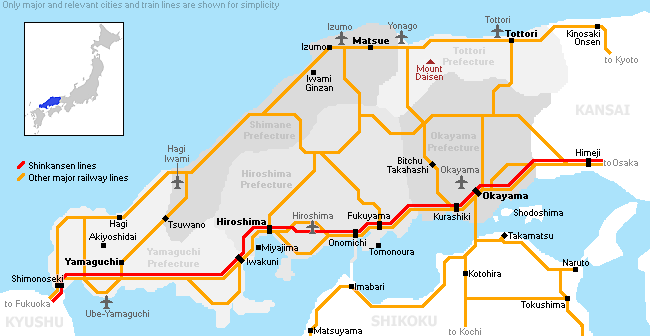
The Chugoku region consists of 5 prefectures: Yamaguchi, Shimane, Tottori, Hiroshima and Okayama. In the last two are the cities of Hiroshima, Miyajima, Okayama and Kurashiki. Chubu begins somewhere half way between Himeji and Okayama. Sum up (Rule: SHOULD is MUST if CAN):

  • MUST VISIT: Hiroshima, Miyajima, Himeji
  • SHOULD: Kurashiki, Onomichi, Okayama
  • can: Iwakuni, Kosanji, Bitchu-Takahashi

広島 : Hiroshima — MUST VISIT, 1 day

wikipedia DE / wikipedia EN / japan-guide

Hiroshima has the Atom Bomb Dome, the Peace Memorial Park and the Museum. The historical importance of this is reason enough to make it a must visit place. Half way between train station and the T-bridge is the old castle ground, there is a very nice japanese garden and the castle. I recommend to book a hotel at Miyajima island  and make Hiroshima a day trip.


TIP: 宮島 : Miyajima/Itsukushima — MUST VISIT, 2 days

wikipedia DE / wikipedia EN / japan-guide

The island of Miyajima is approx. 20 minutes by train away from Hiroshima. Book a hotel on the island and make Hiroshima a day trip. Thank me later. The shrine at night is something awesome. Don’t spoil it by looking to the watch and trying to catch the last ferry back to Hiroshima. I can easily spend a whole week on this island: the famous shrine, a temple with a big hall and a pagoda, hiking at the coast line or up mount Misen. The small town is optimized to day tourist. There are only a few bars open later at night.


岩国 : Iwakuni — can, 2-3 hours

wikipedia DE / wikipedia EN / japan-guide

Iwakuni is a small town, that is in travel distance to Hiroshima and close to Miyajima. The only interesting spots is the famous bridge over the river and a small castle on the mountain. There is also a temple ground. The bridge is 1.2 km away from the train station and is famous because it has 5 arches and is contructed completly out of wood. The castle is small but nice. Everything looks rural, even just around the corner/behind the castle mountain are the Sanyo expressway and the shinkansen tracks.


倉敷 : Kurashiki — SHOULD, 1/2 day

wikipedia DE / wikipedia EN / japan-guide

Maybe it is also a must visit. At the moment I just hold back on this label a use it carefully. 1km south of the train station is an area with ancient houses; white walls, black roof tiles. The central street is located on both sides of a river. It is the place of 2004 where I had this „holiday“ feeling.  There are a lot of small museums and craftmen shops. There is also a shrine but that you can skip if you want.


姫路 : Himeji — MUST VISIT (castle), 1/2 day

wikipedia DE / wikipedia EN / japan-guide

Himeji castle is a perfect stop on the way from Oosaka to Hiroshima. I visited the Castle twice: once in 2004 during Taifun 19 and again in 2014, when half of the castle was closed due to reconstruction. The castle is a must visit. It is the castle of castles, shown in every travel guide. But be aware of all the tourists. There is also a temple area on mount Shosha. Also worth a visit, but it takes some time to get there and back. If you only in Himeji for a brief stop, like I suggested, it might be not possible to visit the temple mountain.


尾道 : Onomichi — SHOULD, 1 Tag

wikipedia DE / wikipedia EN / japan-guide

Onomichi is a small town, not pretty and interesting at first view. There are 25 temples in this city. The temples themself are not that special. But combine that with the narrow back streets and stairs of the town, you have a nice scavenger hunt. I recommend to by a sketch book. Every temple has a stamp. The collection makes a nice souvenir.


岡山 : Okayama — SHOULD, 1/2 Tag

wikipedia DE / wikipedia EN / japan-guide

Okayama is an ideal stop on way from Oosaka or Kobe to Hiroshima. 2km north of the train station is a park Korakuen.  The park is a beautiful combination of japanese and european styles. Right next to the garden, on the other side of the river, is Okayama castle, the crow castle. The castle is open to visitors. There are some more spots to visit, but the fall under the category „if there is some time left“.


Kosanji auf Ikuchijima — SHOULD, 1/2 Tag

wikipedia DE / wikipedia EN / japan-guide

The temple is located on an island between Chuubu and Shikoku. There are ferry connections from Onomichi and Mihara. The temple is something special. Colourful and full of many tiny details. It was founded by a business man in 1936. You can say he went a little bit overboard. The temple is worth a visit. The highlight is a replica of the Yomeimon in Nikko.


高梁 : Bitchu-Takahashi — can, 1/2 Tag

wikipedia DE / wikipedia EN / japan-guide

There is a small castle called Matsuyama in this place. The castle is located on a small mountain. The city itself has a small temple and a small samurai house that can be visited. That is more or less it. Because the place is a little bit away from the usual travel routes, I only gave it a can-visit.


To sum it up: I really good covered the south side auf this area. But I never was at the northern coast within 7 times beeing in Japan.


am ShinkansenHauptlinienNebenlinienabseits (Bus)
Hiroshima **Miyajima ***Bitchu-Takahashi *Inujima Island *
Kurashiki *Matsue *YamaguchiTomonoura *
Onomichi *Izumo *TsuwanoAkiyoshidai *
Iwakuni *Hagi *Mt. Daisen
OkayamaTottoriIwami Ginzan

Listed in the map but no sightseeing spots. There are places to change train or bus lines)

  • Shimonoseki
  • Fukuyama
  • Tottori Airport, Yonaga Airport, Izumo Airport, Hagi Iwami
  • Ube-Yamaguchi Airport, Hiroshima Airport, Okayama Airport

Travel Guide – Kansai

関 西 (K A N S A I)

wikipedia DE / wikipedia EN / japan-guide
[Deutsche Version]

Kansai is the focus for every trip to Japan. Here are the most castles, shrines and temples. If you are short in time you might skip Tokyo (with Kamakura and Nikko) and fly directly to Kansai aiport instead.

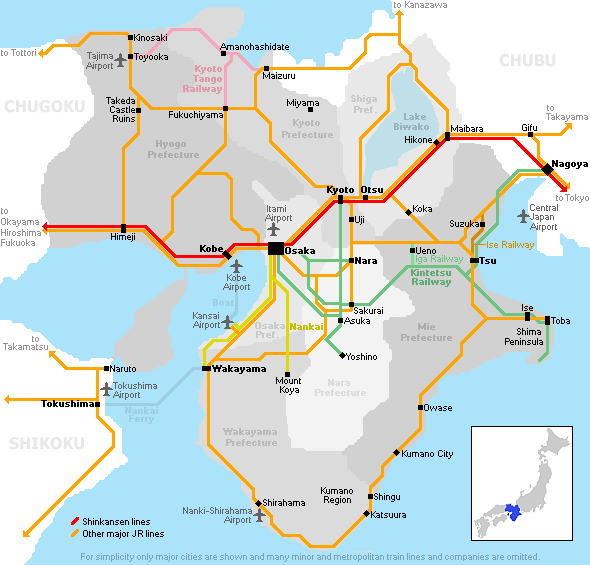
In simple terms the region of Kansai is the area around Kyoto and Osaka and consists of 7 prefectures with many places I consider to be a must visit: Kyoto-ken (Kyoto, Uji), Osaka-ken, Hyogo-ken in the west (Himeji und Kobe), Shiga-ken in the northeast, Mie-ken in the southeast (Ise), and Nara-ken (Ikaruga, Nara) and Wakayama-ken (Koyasan) in the south.


[I’m a fan of japan-guide.com. This picture is a URL link]

The most important places that are be a „must vist“ are:

  • Kyoto — you need at least 2 days
  • Nara — filled with a couple of important temples (daytrip)
  • Koyasan — the temple Mountain (daytrip from Osaka)
  • Himeji — a brief stop between two hotels is enough to visit the castle
  • Osaka — a few very good attraction coverable within a daytrip

京都 : Kyoto — MUST VISIT, 3 days+

wikipedia DE / wikipedia EN / japan-guide

The sightseeing spot are spread all over the cit area. You need at least 2 days to cover the most important places. In difference to Tokyo, Osaka and Nagoya there is a no useful subway. You have to rely a lot on busses and walking. But there are no landlines in Kyoto, that will ruin your pictures. To visit the emperor palace you have to register before (maybe weeks before to get a free spot) and there are only guided tours. More informations I will write on the Kyoto page (I still have to write.

Day trips: Kyoto provides good access to Uji (must visit) and Nara (should vist). Ikaruga (must vist) is also possible but here Osaka is a better place to start.


大阪 : Osaka — MUST VISIT, 2 days

wikipedia DE / wikipedia EN / japan-guide

Osaka has many places to visit, but in total I would rate them not at the top of the list, but the are a „must visit“ for sure. Osaka is only one hour away from Kyoto by train. Therefore you should consider to do one or two daytrips instead of staying in Osaka. The important attractions are: Tennoji, Osaka castle, Sumiyoshi Taisha, Tsutenkaku und Harakas 300 (and Dotomburi at night). In the south is Mozu with its keyhole shape burrial grounds (check it out at google maps). During autumn moon there is a matsuri at Mozu Shrine you really should visit.


奈良 : Nara — MUST VISIT, 1 day+

wikipedia DE / wikipedia EN / japan-guide

Like Kamakura it is a place filled the temples and shrines. If I remember correct it has the biggest buddha statue (Kamakura is only on place 2) and the highest wooden building in the world (I have to check up both facts). Nara is a must visit. if you have to decide between Uji an Nara, you really should go for Nara. Nara is a perfect daytrip from Osaka. Because doing so you can take a brief stop in Ikaruga. You should focus on the highlights. Otherwise the 4:30pm deadline is killing you.


斑鳩 : Ikaruga, Naraken — MUST VISIT, 1/2 day

wikipedia DE / wikipedia EN / japan-guide

This place is a must visit and shouldn’t be a lucky accident like on my first trip to Japan. Holy Moly. The Horyuji is a world heritage and the Hokkiji next door is a national treasure. Warning: If you plan to visit Nara and Ikaruga on the same day, you only can cover the highlights of Nara and it is a tight schedule. You need 2 hours minimum for Ikaruga and these two hour you will miss in Nara. Getting to Ikaruga is possible from Osaka and Kyoto with Osaka beeing the better starting point.


宇治 : Uji, Kyotoken — MUST VISIT, 1/2 day

wikipedia DE / wikipedia EN / japan-guide

Uji is famous for its green tea and the phoenix hall (displayed on the 10yen coin). The tales of Genji (a famous and important peace of japanese literature) is set in Uji. Therefore there is Genji museum. Beside that there are some shrines and temples. My rating is: Nara, Ikaruga, Uji. Uji is accessable from Kyoto; and also from Osaka but with long (time consuming) arrival.


伊勢 : Ise, Mieken — MUST VISIT, 1 day (day trip)

wikipedia DE / wikipedia EN / japan-guide

Ise is the Vatikan of Shinto. The most important shrine is here. In fact, there are two shrines. Both are located in a forest area. The so called outer shrine is 5min away by walk from the train station. There is a bus connection to the inner shrine. There is also a pilgrimage. On the entrance to the inner shrine also begin a very nice shopping street with old wooden houses. Don’t miss it.

You should plan th whole day. Do not make the mistake I did and visit Toba. Ise is also an idea for a base camp to explore the Mie peninsula. Nagoya can be done by 80% as a day trip. Then Toba is an option and the married rocks (don’t know the correct english term) as well, but both places don’t have a high priority. Time consuming travel and not much to see.


夫婦岩 : Meoto Iwa, Mieken — skip it, 1/2 day

wikipedia DE / wikipedia EN / japan-guide

This place is nothing more than two tiny rocks in the water with a rope between them. In Shinto this is a special place. But for a non-japanese tourist … Only visit if you have some spare time. A combination with a visit to Ise is possible, but visit the rocks first. Train connections are not good, specially in the evening. Here Ise also provides some restaurants for dinner.


鳥羽 : Toba, Mieken — skip it, 1 day

wikipedia DE / wikipedia EN / japan-guide

In Toba is the island of pearls. The realm of Mikomoto. The entrance is pricy. Famous attraction are the female pearl divers. But it is not spectacular. You see the boat and the women diving. Next thing you is, that they are back at the surface with a  seashell. Beside that there is nothing intesting that is worth the travel time. If you have your base camp in Nagoya and really have to go to Toba (because of your girl friend), get up early, visit Toba first and after that Ise. Waiting for a train back to Nagoya is a mood killer. Better spend the evening in the shopping street in Ise.


天橋立 : Amanohashidate, Kyotoken — can, 1 day

wikipedia DE / wikipedia EN / japan-guide

Amanohashidate is one of the free famous sceneries of Japan. Sure, the sanbank with all these pine trees is a unique view, but that’s it: a sandbank with pine trees. At the southern side is the train station and a small temple. On the northern side is a shrine and an old temple in the mountains (bus). On both sides is a sightseeing platform. Getting there is difficult. It takes at least 2 hours from Kyoto. It is doable as a daytrip.


姫路 : Himeji, Hyogoken — MUST VISIT, 1/2 day

wikipedia DE / wikipedia EN / japan-guide

Himeji castle is a defintion of a „must vist“. It is the most beautfil and well known castle of Japan. And it is in walking distance of the train station. Therefore this hightlight of Japan can be visited as a stop over if you change location. A little bit away (you need to take the bus) is a temple area in the mountain. The temple is worth a visit but transforms Himeji from a stop over to a full daytrip. Therefore fpor me the temple is only optional.


神戸 : Kobe, Hyogoken — can, 1 day

wikipedia DE / wikipedia EN / japan-guide

Most people associate the big Hanshin earthquake of 1995 and Kobe beef with this city. In the north is Kitano, a ward with a lot of western styled (victorian) houses and a few shrines and temples. Kobe has a small China Town for the evening. In the harbour area are waiting the Merikan Park und Mosaic (Kobe Harbourland). As fas as I remember my time in Kobe, it is only a should visit and therefore is something for a longer stop over or a daytrip from Osaka. There is a ferry boat from Kobe airport to Kansai airport.


和歌山 : Wakayama, Wakayamaken — can, 1/2 day

wikipedia DE / wikipedia EN / japan-guide

Wakayama has a castle. It is not a small one and also not an ugly one. But, that is all that Wakayama has to offer. I only stayed in Wakayama because of the ferry boat to Tokushima (Shikoku). Oh yes. I Wakayama is the beginning of the Tama train line. The other terminal is in a very small town; not important. But the station master of that train station is a cat called Nitama.


高野山 : Koyasan, Wakayamaken — MUST VISIT, 1 day+

wikipedia DE / wikipedia EN / japan-guide

Koyasan is the temple mountain of Japan an the centre of Shingon Buddism. Highlight of Koyasan is the temple Okuno-in an the 1,3 miles long path thru the forest, that in fact is a cemetry with over 200.000 tomb stones. The other attractions are Kongobu-ji, Daishi Kyokai, Garan and the Tokugawa Mausoleum. I’ve visited Koyasan on a foggy day. From my point of view the best weather to walk thru the forest. Travelling to Koyasan is easy with Nankai line, that starts on south Osaka.


桜井 : nahe Sakurai, Naraken — can, 1/2 day

wikipedia DE / wikipedia EN / japan-guide

Sakurai is a city in the middle of of Nara. Close the city is the Hasedera, a beautiful temple. Close the Sakurai is also the Tanzan shrine with it’s 14-story-pagoda. The shrine looks old and rundown, but this adds to its mystical aura. Both places are really worth a visit. But. Hasedera is barely in walking distance from the train station. Tanzan is worst. The shrine is in the mountains and busses going very infrequently. Therefore both places are only a „can visit“.


吉野 : Yoshino, Naraken — can, 1/2 day

wikipedia DE / wikipedia EN / japan-guide

Yoshino is a little bit offside and only features a long street with 4 temples und 2 shrines. Without cherry blossom there isn’t much to see. The temple and shrines without cherry blossom are noth worth a visit (except you have visited all the other places south of Osaka already). But during cherry blossom there are over 30.000 trees waiting for spectators. For travelling to Yoshino I recommend Kintetsu railway, starting in Abenobashi (south Osaka, next to JR Tennoji station). But you have to change trains.


彦根 : Hikone, Mieken — can, 1/2 day

wikipedia DE / wikipedia EN / japan-guide

Hikone is a small town, that can be visited if there is some time to kill. Hikone hat a castle, a japanese garden Genkyu-en and the shopping street called „castle road“ with some old style houses. The castle is small but cute. Hikone is located at the Tokaido-trainline between Kyoto an Nagoya at the shore of lake Biwa. Normal trains stop here. The next Shinkansen stop is one station away in Maibara.


am ShinkansenJR-LinienJR-Liniennon-JR-Streckenabseits (Bus)
Kyoto ***Nara ***ShirahamaMt. Koya *** Iga Ueno *
Himeji **Ise **KutsuuraAmanohashidate *Miyama
Osaka **Kinosaki **ShinguYoshino *Kumano region
Kobe *Uji *TobaAsakusa
MaibaraTakeda *OwaseSuzuka
Kumano *Koka
HikoneTsu
Wakayama

Listed in the map but no sightseeing spots. There are places to change train or bus lines)

  • Maizuru, Toyooka (connecting station for Amanohashidate)
  • Fukuchiyama (connecting station)
  • Tsu (connecting station between JR, Ise Railway and Kintetsu)
  • Kansai Airport, Itami Airport (Osaka, International)
  • Kobe Airport, Tajima Airport, Nanki-Shirakama Airport

Travel Guide – Chubu (South)

中 部 地 方 (C H Ū B Ū)

[Deutsche Version]

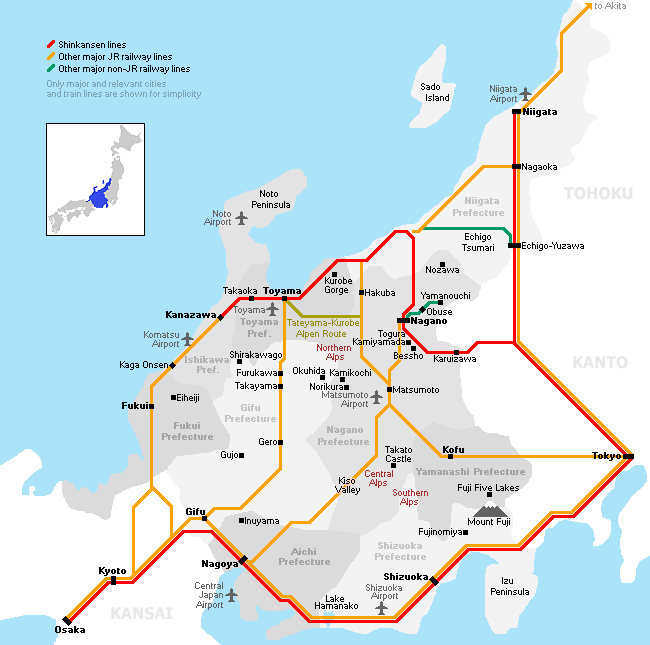
Chuubu is the region between Kansai (Osaka and Kyoto) and Kanto (Tokyo). Historically Chuubu is part of the Kansai area. The nine prefectures of Chuubu are: Shizuoka, Aichi, Yamanashi, Nagano, Gifu, Fukui, Ishikawa, Toyama and Niigata. The eastern border is east of Izu peninsula and goes straight up to east of Niigata. The western border starts west of Nagoya and then runs northwest. Lake Biwa is on the Kansai side.


[I’m a fan of japan-guide.com. The pic is a URL-Link to the website]

The Tokaido Shinkansen tracks are in the south, next to the coastline. Since 2015 (?) the Joetsu Shinkansen, that connects Nagano and Tokyo goes further north to Joetsu-Myoko. There it becomes the Hokuriko Shinkansen and runs along the northern coast to Kanazawa. (It is planned to go further to Fukui and than to join the Tokaido.) The northmost prefecture of Chuubu is connected to Tokyo by the Niigate Shinkansen.

There are main lines from Nagoyo thru Kiso Valley to Matsumoto and Nagano and another one over Gifu to Takayama and further to Toyama. Another main line runs along the northern coast an connects Fukui, Kanazawa, Toyama, Myoko and Nagaoka. Beside JR there are a lot of other private lines.

Because of the many places I have split the post about Chuubu into two posts. I used the Nakasendo / chuo line for that. The highlights are Nagoya, Fuji, the Kisodani, Matsumoto und maybe Gifu.


名古屋 : Nagoya — MUST VISIT, 1-2 days

wikipedia DE / wikipedia EN / japan-guide

This city is a must visit and if you are good, you only need one day. You should visit three places: the castle, the Japanese Garden in the North of the city (and the museum next to it) and the big and important shrine in the South. Nagoya is a good base camp for day trips to Gifu, Inuyama, Ise and (maybe) Toya. A stopover visit to Nagoya is possible, because the shinkansen between Kyoto/Oosaka and Tokyo stops here.


岐阜 : Gifu — MUST VISIT, 1 day (day trip)

wikipedia DE / wikipedia EN / japan-guide

Gifu is doable as a day trip from Nagoya or optional as a stopover on the way from/to Takayama. If you want to watch the cormoran fishing you have to stay until late at night. But then there are only trains to Nagoya available. There is a bus from the train station to the river. Get of the bus there and visit the temple and the shrine nearby. The temple has an old Daibutsu. At the slope of the mountain is a pagoda. At the mountain top is an old castle with a small museum. You can walk or take the ropeway; depends on the time left before it is getting dark.


犬山 : Inuyama — (not rated yet) 1 day

wikipedia DE / wikipedia EN / japan-guide

Half distance betweeen Nagoya and Gifu is Inuyama. The train connection are not perfect but ok and this place is worth a visit. Because I messed up the travel route I only could visit a tiny part of Inuyama and missed most of the attractions. Therefore I will visit Inuyama again and rate this place afterwards. Inuyama seems to be a good candidate for a daytrip from Nagoya. In opposite to Gifu, Inuyama is not good for a stop over on the way to Takayama.


木曽路 : Kisodani / 中山道 : Nakasendo — MUST VISIT, 1 full day

wikipedia DE / wikipedia EN / japan-guide

Kisodani, a valley in the mountains between Nagano and Gifu prefecture, is a piece of ancient Japan. There is a hiking trail called Nakasendo. It is an historic trading route, compareable to the Tokaido, that connected Heian (Kyoto) and Edo (Toyko). In ancient times there were several post towns. Two of them are Magome and Tsumago.

My suggestion: Visit one town than walk the 7km on the Nakasendo to the other town. There are busses between both towns for the way back (and to the train stations). This trip will take a whole day. You have to stay for at least 2 nights or one night and a late train to the next base camp, There are more post towns in Kisodani but you need the help of very good hiking shoes or a Japan Rail. Since my visit in 2012 this place for sure is part of my „must visit list“.

The train that goes along the Kisodani is the Chuo-Line. The very same Chuo-Line that intersects the Yamanote ring in Tokyo at Kanda and Shinjuku. Therefore, all you need to get to the Kisodani is get in the train and wait. Be aware: The is a Super Limited Express at Chuo Line between Nagoya and Matsumoto that doesn’t stop in Margome or Tsumago. I know because I took it in 2012 by accident and nearly run aground in (Kiso)Fukushima.


松本 : Matsumoto — SHOULD, 1/2 day

wikipedia DE / wikipedia EN / japan-guide

The castle is a good argument for Matsumoto. But this the only one. The castle is a little bit away from the train station, but in walking distance. My recommendaction is similar to Nagano: good for a stop over. But Matsumoto is not interesting enough for a day trip.


富士河口湖 : Fuji-Kawaguchiko — can, 1 day

wikipedia DE / wikipedia EN / japan-guide

This place only has one advantage: It is right next to the Fuji. You can start the full hiking tour here or take a bus to the 5th station. There is a connection by bus and train to Shinjuku. (Remember: For the Japanese Shinjuku is not Tokyo.) But there is nothing to visit. The sea is one of the five Fuji lakes. Two other are accessable by hiking. A bus helps to shorten the walk. There are two caves. But they are not that fancy. Kawaguchiko is a high price area, because of its good connection to Tokyo and the view to the Mt. Fuji from the onsen bath tub. If you really stay here, make a visit to the local micro brewery. The restaurant there is nice. The suicide forest is also around the corner.

My suggestion: Spend a few days in the mountain and then turn into a pricy onsen hotel for relaxiation for one night, maybe two. If you mention the Fuji hiking you are a welcome guest. I stayed in Hotel Sansui. Awesome. I don’t have to check out the other hotels. (here are some pictures in my post from 2006)


富士山 : Mt. Fuji — SHOULD, 1 day;
over 2 days for the complete mountain experience

wikipedia DE / wikipedia EN / japan-guide

The Mt. Fuji si 3776m high and Kawaguchi is 700m above sea level. With other words: If you are standing at the summit, you can watch down 3000m of height. This isn’t possible in the alps. Going up to station 7 is kind of easy (comparing to the rest). Arriving station 5 is even easier. because there is a bus. Extrem early birds with good physical condition can go up and down in one day from/to station 5.

The hghlight is to watch a sunrise at the summit. This requires to stay of night in the mountain at one of the stations huts. If possible at close as possible to the summit. You don’t want to hike longer distances in the dark. Believe me. It also requires preperation (clothing, money, planning, booking). The station huts are small and cramped. Camping is not allowed and also not possible.

If you want to go the complete distance you have to start in Kawaguchi at station 1. This is still on my list. I will need at least 3 days. I don’t want to climb 3000m of height in one day. Going downhill is easier but also dangerous (it strains the knees, you easily accellerate and trip; and you still exhausted from going uphill).

I you arrive from Tokyo, do not use the Shinkansen. It is a very long journey. Plan your destination to be Kawaguchi and use the bus or train departing fro Shinjuku.


am Shinkansenan Hauptliniean Nebenstreckenabseits
NagoyaKisodaniObuseShirakawa-go
ShizuokaMatsumotoYamanouchiEiheiji
KaruizawaHakubeBessho OnsenNoto Peninsula
NaganoGifuFive LakesSado Island
ToyamaGeroGujoIzu Peninsula
TakakokaTakayamaTakato CastleOkuhida
KanazawaFurukawaToguraKamikochi
Echigo-YuzawaKaga OnsenFujinomiyaNorikura
NiigataFukuiKurobe GorgeMt. Fuji
UedaLake Hamanako
Echigo-Tsumari
Nozawa Onsen

Following place are listed in the map but are no sightseeing spot. There are places where you need to change trains or busses.

  • Central Japan Airport (national airport, Nagoya)
  • Kofu
  • Nagaoka